Your Sleep Score Told You Something Was Wrong. It Never Told You Why.
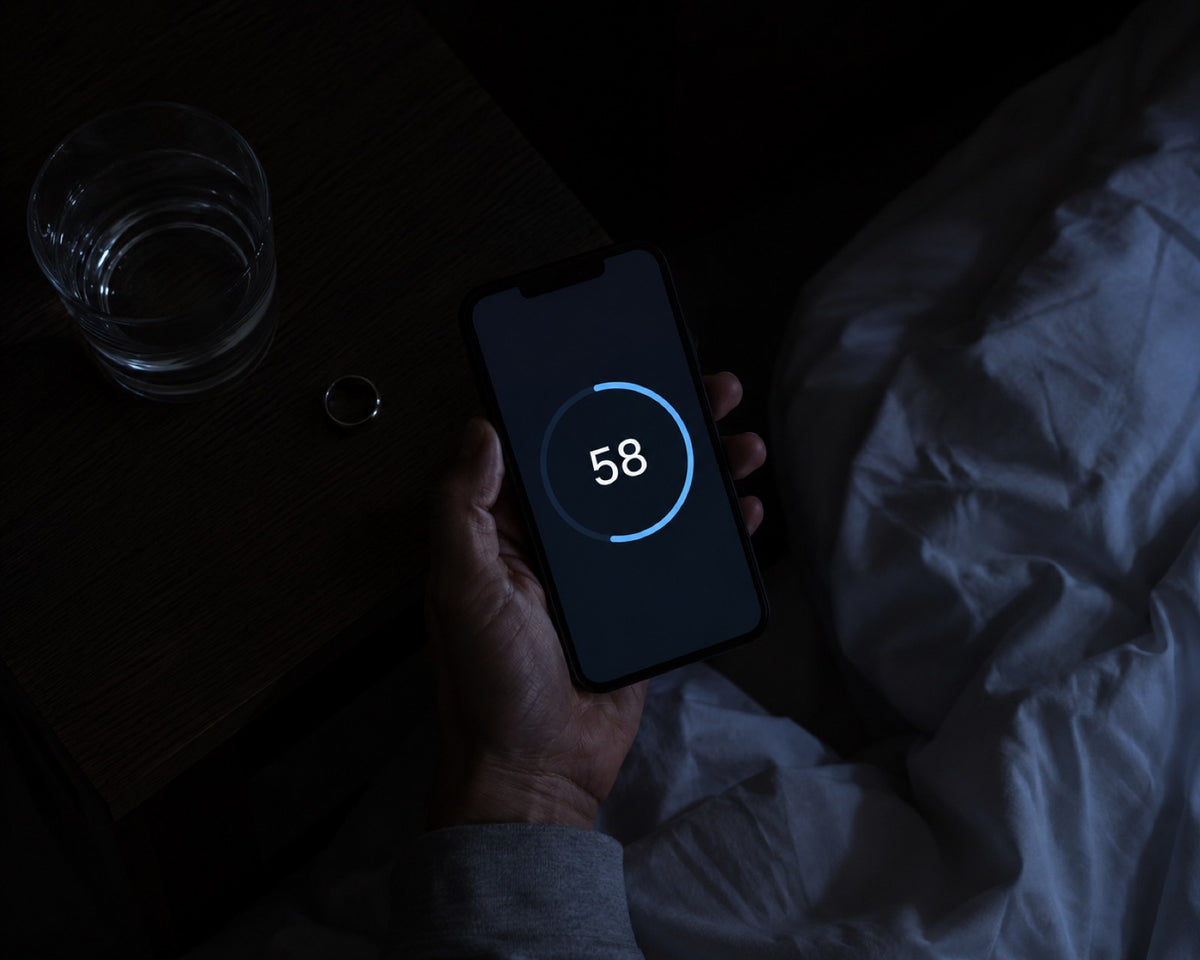
You wake up before the alarm, which is its own kind of insult, and the first thing you do is reach for the number.
Sixty-one. Or fifty-eight. Or the word "fair," which is somehow worse than a number.
You already knew. You did not need a ring, a watch, or an app to tell you that you feel like you were hit by a truck at 3am. You bought it because you were hoping that this time, something would tell you what to actually do about it.
It never did. It gave you a graph. A colored bar. A recovery percentage that goes down on the days you can least afford it. And then it gave you the same thing again the next morning, and the morning after that, for two years.
Sleep shouldn't cost tomorrow. But somewhere in there, measuring it started costing you something too.
What the number is actually measuring
A tracker watches movement, heart rate, and temperature, and it makes an educated estimate of what your night looked like. Some of them are quite good at it. Used well, they are honest about trends. If you drank at 9pm, you will see it. If you have been sliding for three weeks, you will see that too.
Here is the part nobody puts on the box.
Every one of those measurements is a report on the outcome. It is very good at telling you what happened. It was never built to tell you why. It is the check engine light with no mechanic attached, and you have been staring at it every morning for two years waiting for it to say something new.
A score told me my night went badly. It never once told me what to fix.
The reason nobody put on your dashboard
You are not failing at sleep because you lack discipline. You have discipline. You run a household, or a team, or both, on four hours of good sleep and a lot of coffee, and you have been doing it for years.
You are lying down every night with a nervous system that never got the signal to power down.
That is the actual thing. You spent the day in a state of alert, because the day required it, and your body kept metabolizing that day long after the day was over. Cortisol on top of caffeine on top of a phone. So you get into bed exhausted, which feels like it should be enough, and your brain starts filing. The email you did not send. The thing your kid said in the car. A conversation from 2019.
Tired but wired. It is the most common thing I hear, and it is not a personality trait. For a lot of people it is a nervous system that never made the switch.
This is also why being exhausted is not always enough to make you sleep. People assume enough tiredness eventually wins. Usually it does. When it stops winning, something is overriding it, and that something is the part nobody measured. If the switch never flips, you can lie there for nine hours and get up owing more than you did the night before.
What the measuring did instead
Here is my honest read on the tracker years, and I say this as someone who still wears one.
The number did not fix anything. It gave the problem a face, which felt like progress for about a month. Then it turned bedtime into a test you could fail. You started doing math on your own recovery at 11pm. You woke up, read a 58, and wrote off the day before you had brushed your teeth.
An industry sold you awareness. Awareness that never resolves into a cause is just a more expensive way to worry.
And this is the pattern underneath everything I write here. The sleep business is very good at describing your problem back to you. Naming it. Charting it. Selling you something that takes the edge off it. It is much less interested in the part where the problem ends, because a fixed customer stops being a customer.
What I would do with the number now
Stop grading yourself nightly. One bad night is not data, it is Tuesday. Look at two weeks at a time or do not look at all.
One caveat I am not going to skip. A tracker cannot diagnose you, and neither can I. If your nights have been bad for months, or you snore, or you wake up gasping, or you are exhausted no matter what you change, that is a conversation with a doctor and not a supplement. Some of what looks like depletion is something else, and it is worth ruling out.
Then go after the reason instead of the score.
That is the whole idea behind OVRNITE. Not sedation, which is what most of the shelf is selling you. Sedation gets you unconscious. It does not get your nervous system to stand down, and there is a real difference between being knocked out and being restored. OVRNITE is designed to support the body's own wind-down chemistry, so the system has a better chance of standing down and the night can do its work.
You will not see it as a perfect score on day one, and it will not be the same for everyone. The first thing that tends to shift is the evening. The hour before bed stops being a fight. From there it can reach the mornings, and later the afternoons, and that part takes longer than anyone wants it to.
If the number catches up, it will be the last to say so. It usually is.
Feeling like yourself again doesn't happen overnight. It starts there.
Chad MillerFounder | Maxen Health