You Weren't Asleep. You Were Sedated.
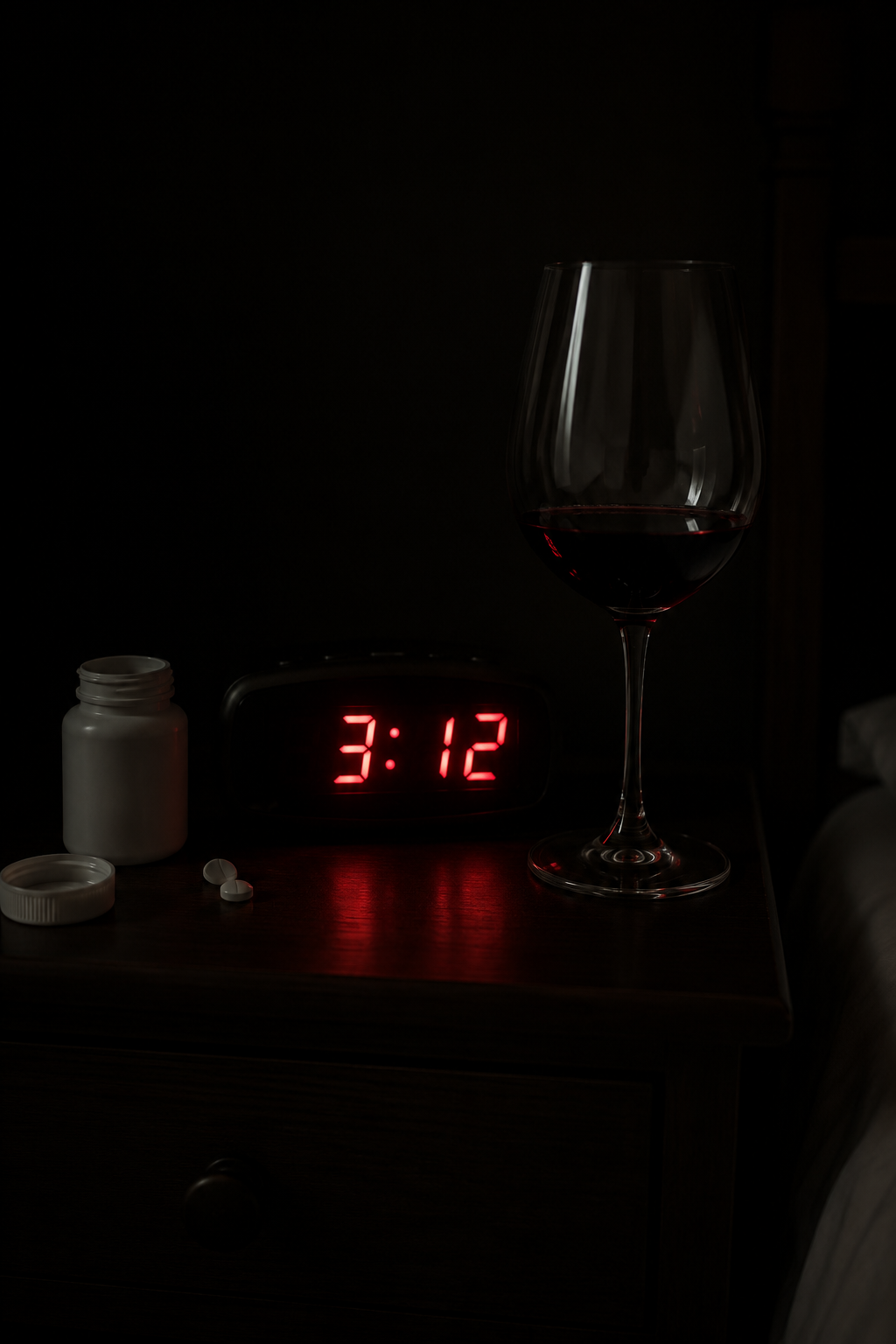
There's a version of this that happens at 10:40 on any given Tuesday night.
You've been up since 5:00 AM. You're done. Exhaustion has been your companion since mid-afternoon.
The book on your nightstand has a thin layer of dust, and tonight, like every night before, it'll collect a little more.
The breathing technique you learned about on social media? Not tonight.
So, you pour a second glass. Or, you reach for the Benadryl conveniently in your nightstand drawer. You bought it for allergies, but kept it for nights like this.
20 minutes later, you're unconscious.
Then, right on schedule, it's 3:12 AM. You're wide awake. Heart racing as panic sets in that you won't fall back asleep.
Sleep shouldn't cost tomorrow. And, yet, here you are. Another groggy start to what will be a caffeine-fueled day.
The only thing the category ever agreed to measure
Walk the sleep aisle sometime. Read what's promised on the labels.
Fall asleep in 20 minutes. Knocks you out. Drift off fast.
Every promise is about the same moment. The gap between lying down and going under. Nobody makes a claim about 4:00 AM. Nobody makes a claim about the 10:00 AM meeting where you can't find the words you're looking for.
There's a reason for that, and it isn't modesty.
Speed to sleep is the one thing you can feel on night one. It's immediate. It's measurable. It sells a second box.
But the seven hours after you go under? You feel none of it. The cost takes weeks to surface. And it's the only part that was ever going to matter.
Being switched off isn't the same as being restored.
What's actually happening while you're out
Start with the one nobody sells you as a sleep aid, because nobody has to. It's the most common one in the country.
Alcohol. It gets you under, and it gets you under fast. That's the whole appeal. And it's the whole problem.
Getting you under is all it does. Somewhere in the back half of the night it wears off, and the night comes apart. You surface at 3:00 AM, wide awake, heart running faster than a resting body should, lying there doing the math on how many hours are left before the alarm.
So you decide you're someone who "just wakes up at 3:00 AM." You're not. You had a chemical wear off in the middle of your night.
Then the Benadryl.
Diphenhydramine, the stuff in ZzzQuil and Benadryl, wasn't built to help you sleep. It was built for allergies. Drowsiness was a side effect someone noticed and turned into a product line. That's the whole origin story. And the fog you wake up in isn't you being weak in the morning. It's a compound that's still in your system at 7:00 AM.
Then melatonin. Still the default. Still misunderstood.
It's a timing signal. It tells your body when it's night. It was never built to fix why your body won't stand down once night comes. That's why it stops working. That's why you kept bumping the dose until you gave up on it.
Three different things people reach for. Not one of them built around what the night is actually for.
What the night is for
I didn't understand this until my own body forced me to.
Sleep isn't an off switch. It isn't idle time. It's the shift when the work gets done.
Your body repairs tissue. Your brain files what you learned that day and clears the waste it made getting through it. Hormones reset. The nervous system, braced for 14 hours straight, finally gets to stand down.
Sedation doesn't run that shift. It shuts down the thing that was supposed to run it and holds you still while the hours pass. You spend the whole night in bed. Your body does none of the work sleep is for.
That's the whole distinction. And once you see it, you can't unsee it. Unconsciousness is a state. Restoration is work.
The industry sells the state, because the state is the part you can feel on Tuesday. The work? It leaves that entirely to you.
The part I'm not going to skip
I'm not a doctor, and this piece can't examine you.
If your nights have been bad for months, if you snore, if you wake up gasping, if you're wrecked no matter what you change, that's a conversation with a doctor, not a supplement. Have it sooner than you want to. Some of what looks like depletion is something else, and it's worth ruling out.
And if you're pouring a drink every night to get to sleep, that's a conversation worth having with someone too. I'm not going to dress it up as a sleep habit.
If you take a prescription sleep medication, none of this is a reason to stop. That's between you and the person who prescribed it.
What we built instead
OVRNITE isn't designed to knock you out. That was the whole point of building it.
It's built to support your body's own wind-down, the process that's supposed to happen on its own and stopped somewhere in the last few years. Melatonin-free. Not a sedative. The goal was never speed to sleep, because speed to sleep is the metric that got everyone into this mess.
Here's the honest part.
It doesn't feel like being hit with a bat. If that's what you're used to, the first few nights can feel like not much is happening. When it does start to shift, the evening tends to go first. The hour before bed stops being quite the fight it was. That's smaller than the shelf promises you. It's also real, and it isn't the same for everyone.
We're not going to promise you'll sleep in 20 minutes. Everyone tells you that. It's the promise that's let you down more than any other.
Feeling like yourself again doesn't happen overnight. It starts there.
Chad MillerFounder | Maxen Health